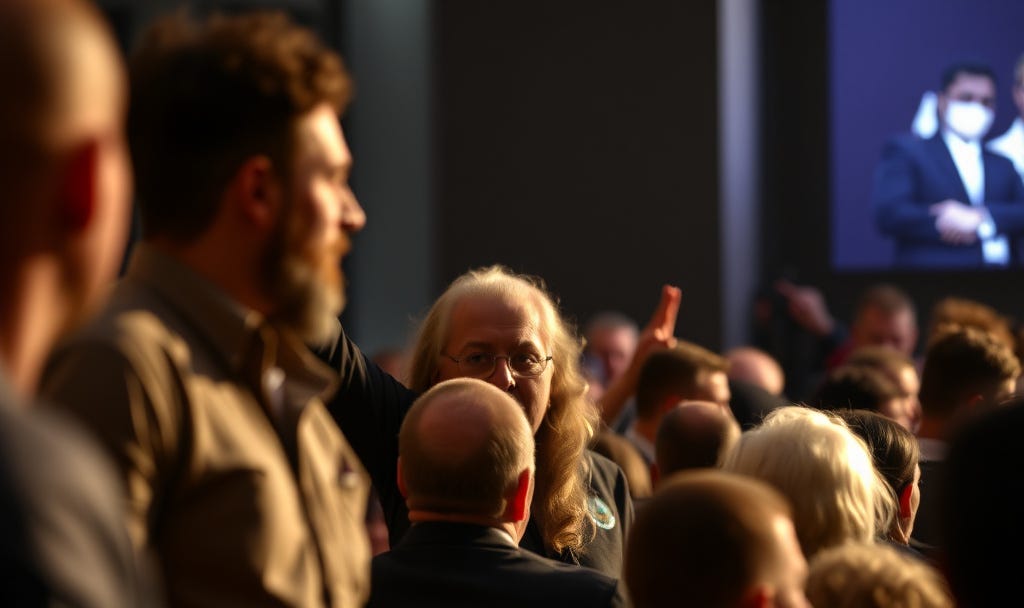
Not leadership as pose, but as method: scars as maps, logistics before stage, purpose as the only real light.
Aug 08, 2017
Leadership isn’t a lighthouse that blinds; it’s a smart clearing, a surgical cut through the forest of uncertainty. It’s an operational lucidity that lights just enough to move forward, while keeping the night as perimeter: darkness stays in place to play its tactical role — to remind us of limits, costs, risks, mysteries. To lead is to grasp that the night is not an enemy; it’s context and encryption. It hides what doesn’t need to be seen yet and protects what is still in gestation. Raw light only pushes things away; strategic clarity pulls people closer. It reveals the terrain, measures the reach of danger and, above all, makes sure the team keeps seeing its own shadow — a condition for humanity and for ego calibration. A leader doesn’t work with spotlights; they work with infrared, reading the heat of purpose where others see nothing but noise.

It is also the patient engineering of raising invisible scaffolding — supports that don’t demand credit. Good leadership is like the anonymous architect at the margins of the blueprint: they guarantee angles, loads, and tensions, and let the work appear free of vanity. In chess, that’s called playing “positional”: you’re not chasing applause for brilliant moves, you’re chasing quiet advantage on the right files. Leadership then becomes a compass that refuses the easy magnetism of shortcuts — seductive for their speed, insanely expensive in principles. It insists, even under storm, on an ethical north that does not wobble. It isn’t a voice fighting for decibels; it’s full-spectrum bandwidth. It opens space not so that everyone speaks in chorus, but so that each voice finds its own frequency — a choir tuned by purpose, not ego.

A leader reads scars the way others read maps and the way strategists read nautical charts: in them they recognize crossings already made, reefs narrowly avoided, falls that taught more than entire treatises. They watch the tides in the breathing rhythm of the group, sense micro-tensions like a human seismograph, and understand hesitations before they turn into breakages. They are a resilient bridge — calculated for the weight of the unexpected and also a humble ford that lowers itself so others can cross with less effort. They don’t bark orders; they ask questions — and they keep asking until the question finds its verb, its why, its inevitable action. They don’t make big promises; they practice craftsman-level loyalty: small daily welds, invisible to the public eye, that in their quiet accumulation become the foundations of a city. In campaign terms, leadership is logistics before stage time; in physics terms, it’s torque before speed.

They make mistakes with minimum ceremony: they tie the error to the dock, strip it of its arrogance, and turn it into a manual and a checklist. They get things right with detachment: they hand the credit back to the current that brought it, like a sailor acknowledging that it was the wind that delivered the ship. They know time is an ally — not a problem — so they de-rust silences, brush off the dust of misunderstanding, and collect microscopic signals — the half-second pause before an answer, the absentminded weight of a sigh — and convert them into route, adjustment, listening. They are radar and filter at the same time: they pick up everything, but they log only what’s essential.

They don’t chase applause: applause manufactures an audience, and audiences don’t move; they wait for a show. They prefer precision: a half-degree correction today saves weeks of frustration ahead. They don’t collect followers; they grow continuers — people capable of holding the cause when the leader is not in the room, people who understand that legitimate leadership doesn’t climb onto pedestals; it hands out tools, protocols, and criteria. It doesn’t build a cult; it builds culture. It doesn’t create dependency; it multiplies discernment.

And when the night tightens and it always tightens — the leader is an ember: they offer warmth without burning anyone out; they heat without turning the other into fuel. They’re a low-coast lighthouse: they guide whoever is sailing without stealing the authorship of the journey. Leadership is this rare engineering of listening and direction; this lucid courage that opens paths without cutting the line; this unglamorous duty of being the first to arrive at the problem and the last to leave the responsibility. It’s a command that knows how to shift gears: sometimes advance, sometimes strategic waiting, sometimes tactical retreat to preserve strength and morale. And then, when the natural rhythm of leading is finally understood, it becomes clear that destiny was never a throne, a post, or an epilogue: it was always a demanding gerund: serving.

Above all, to lead is to manage narrative energy. It is knowing that every decision is a paragraph in the book of an institution, that every silence is punctuation, and that legacy is written in the choice of subject (“we”) and the verb tense (a future built in the present). To lead is to guard boundaries so that what is essential doesn’t dissolve; it is to choreograph talent so that the whole outperforms the brilliance of any solo. It is to keep the fire of purpose burning with discipline — no fireworks, no cheap hype — and to accept that greatness is less a proclamation and more a method. Because, in the end, leadership is the art of turning intention into infrastructure — and infrastructure into impact.